
Transformation program
Building a Lean Production System
We build the company's production system — from the audit and flow design to autonomous teams that sustain results without a consultant. Everything you need for growth is already in your company. We add the vision and the energy for change.
Logic of change:
Phases I–II, seven stages
First step
Production system
audit
Format
At your site, without stopping production
Result
Phase III: the system works without a consultant
- Logic
Phases I–II, seven stages
- First step
Production system audit
- Format
At your site, without stopping production
- Result
Phase III: the system works without a consultant
Trusted by:













When it is time to start
This program is for you if
- You don't know where you are or where you are going
There is no assessment of the production system’s current state or target state.
Improvement initiatives start and fade because it is unclear what they will deliver and to whom.
- People don't carry the change
Supervisors don’t know their processes’ numbers: cycle time, whether an operation fits takt, where the hour gets lost.
Improvements rest on two or three people.
- Losses are not counted
Scrap, downtime, changeovers and OEE are lower than the plan requires.
Staff are not involved in improving their own processes.
- Losses are not counted
Scrap, downtime, changeovers and OEE are lower than the plan requires.
Staff are not involved in improving their own processes.
- Everything depends on the supervisor
Hand out tasks at 8:00, firefight from 8:00 to 18:00, learn the result at 18:00.
Meetings run “as the situation requires”, not by a standard.
- Everything depends on the supervisor
Hand out tasks at 8:00, firefight from 8:00 to 18:00, learn the result at 18:00.
Meetings run “as the situation requires”, not by a standard.
- You have 5S and OEE, but the effect doesn't last
The tools are in place but live separately from daily management.
As soon as a manager’s attention shifts, the indicators slide back.
- You plan to expand because “capacity is short”
Before building a new workshop or buying equipment, check what percentage of the existing flow’s potential is actually used.
If you recognize at least two of these situations, it is not a people problem and not a tools problem.
No organization has ever outperformed its leadership team: what happens on the shop floor reflects the management system. That is where we start.
Transformation phases
THREE PHASES OF THE TRANSFORMATION PROCESS
The program runs through two phases over twelve months and prepares the organization for the third — the one that has to live without a consultant. Most attempts fail precisely because they skip the first phase and go straight to tools.
Phase I · Changing the self-image
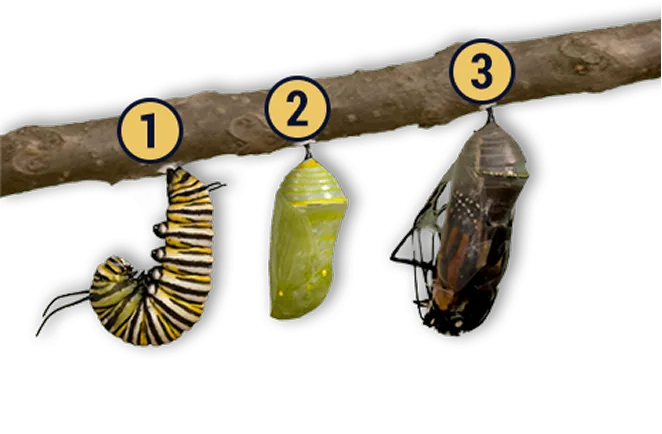
Restoring the organization's health
STAGE 1. Audit, planning and management engagement
Project charter, a coordination council with a mandate for change, a strategy session: vision, must-win battles, indicators. A current-state and target-state flow map.
STAGE 2. Providing information support for change
A loss-collection system (OEE, OTIF, DPM), Loss/Cost Deployment, three-level information centers, a KPI tree, communicating the vision to every employee.
STAGE 3. Developing people and daily management standards
Autonomous teams and the 8-minute meeting, a supervisor’s standard workday, Gemba Walk, Kamishibai, manager coaching.
Phase II · New skills. New behavior
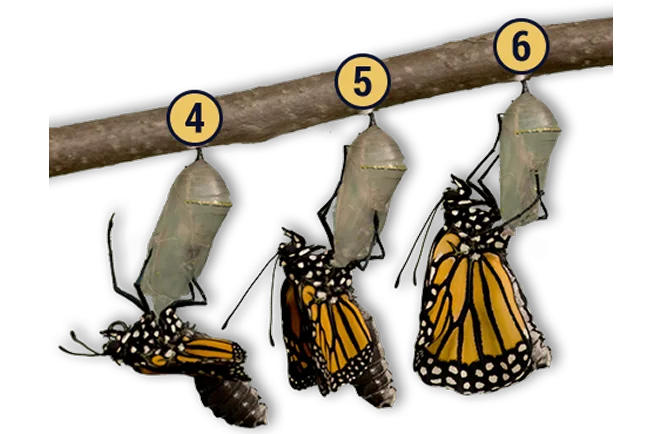
Optimizing processes and flow
STAGE 4. Standardizing processes and the work environment
5S and visual management, autonomous equipment maintenance, standardized work in manual operations, planned preventive maintenance based on ABC analysis, job instruction training (TWI).
STAGE 5. Focused improvements in the flow
Project teams in pilot areas, SMED, warehouse and inventory, batch validation time — projects from the strategy session with calculated ROI.
STAGE 6. Policy deployment and KPIs from local goals
Hoshin Kanri: company goals cascaded to the work area; KPIs of mini-business teams (CDI Way); linking productivity to pay.
Phase III · Maturity. Kaizen culture
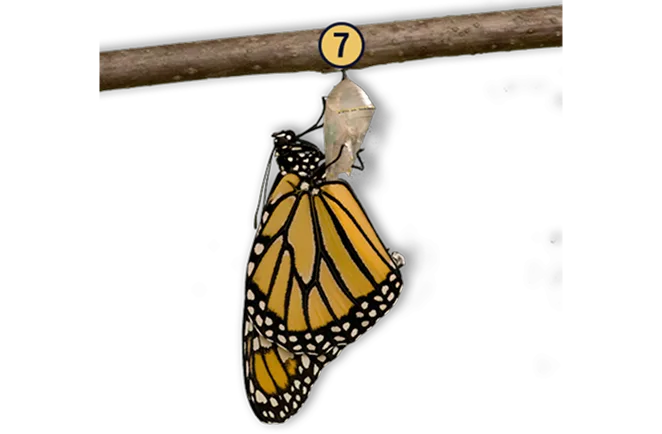
Operational excellence
STAGE 7. Turning new practices into cultural traditions
Management routines become the norm of the working day. Staff change standards themselves. Problems are solved where they arise. The goal is sustainable productivity growth every year.
WHAT REMAINS FROM US. Support on request
An annual production system maturity assessment, coaching for new team leaders, participation in LeanForum and lean tours of other clients’ plants.
Beyond the program: the system works without a consultant. This is not a project stage but its success criterion.
What changes
What the company looks like in each phase
Four dimensions in which both we and you see progress. Every cell is something you can verify on the shop floor, not in a report.
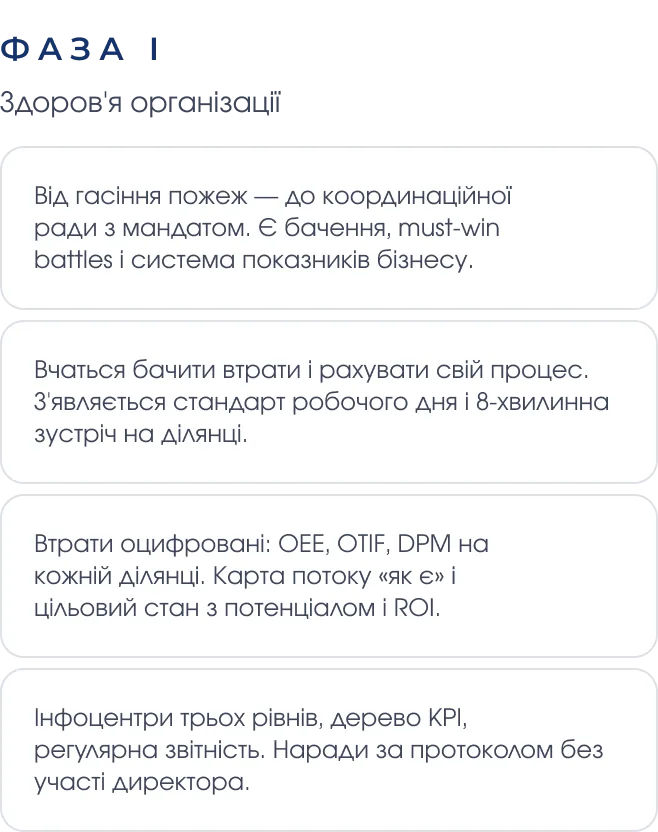
Phase I
Organization health
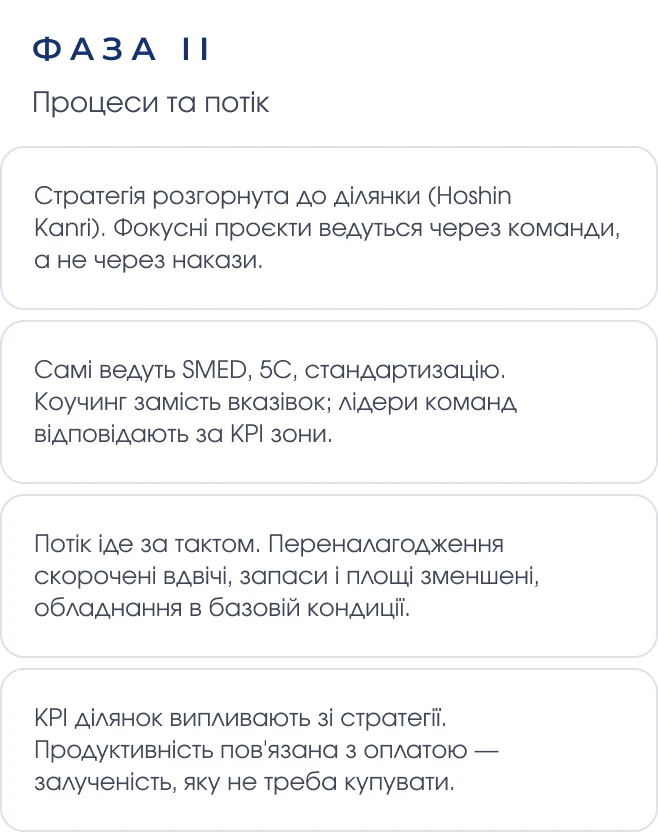
Phase II
Processes and flow
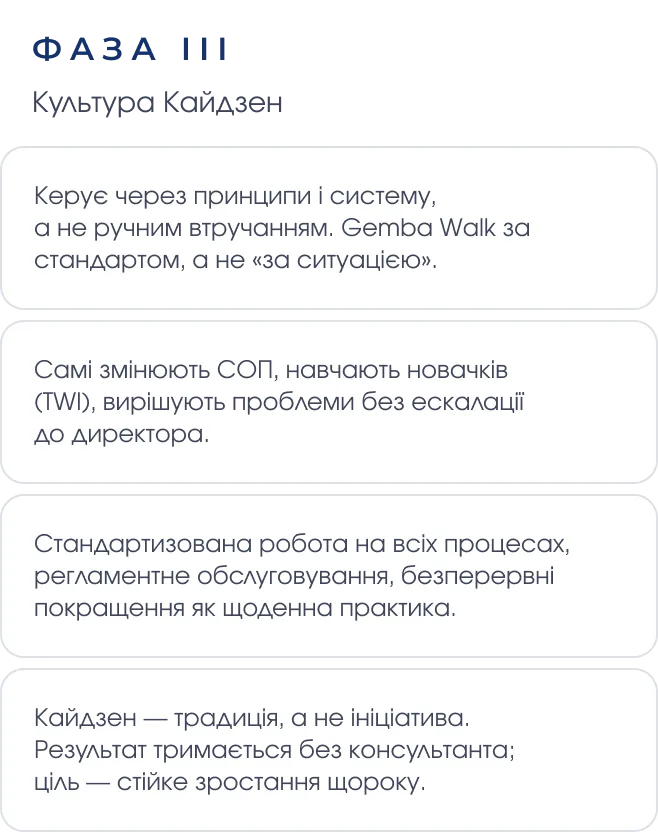
Phase III
Kaizen culture
- Leadership
From firefighting to a coordination
council with a mandate. There is a vision, must-win
battles and a system of business indicators.
Strategy is cascaded to the work area (Hoshin
Kanri). Focus projects are run
by teams, not by orders.
Leads through principles and the system, not
manual intervention. Gemba Walk by
standard, not “as the situation requires”.
- Supervisors and teams
Learn to see losses and measure their
process. A standard workday and an
8-minute area meeting appear.
Run SMED, 5S and standardization
themselves. Coaching instead of instructions; team leaders
own their area’s KPIs.
Change SOPs themselves, train newcomers
(TWI), solve problems without escalating
to the director.
- Processes and flow
Losses are quantified: OEE, OTIF, DPM in
every area. A current-state flow map and a
target state with potential and ROI.
The flow runs to takt. Changeovers
are cut in half, inventory and floor space reduced,
equipment in baseline condition.
Standardized work in all processes, scheduled maintenance, continuous improvement as a daily practice.
- Indicators and culture
Three-level information centers, a KPI tree,
regular reporting. Meetings run by protocol
without the director.
Area KPIs flow from the strategy.
Productivity is linked to pay —
engagement you don’t have to buy.
Kaizen is a tradition, not an initiative.
Results hold without a consultant;
the goal is sustainable growth every year.
- Leadership
- Supervisors and teams
- Processes and flow
- Indicators and culture
THE PROGRAM’S PROCESS SYSTEM IS HARMONIOUS:
each tool plays its role but cannot on its own deliver the result the system as a whole can.
WHAT WE BUILD
A production system of five elements
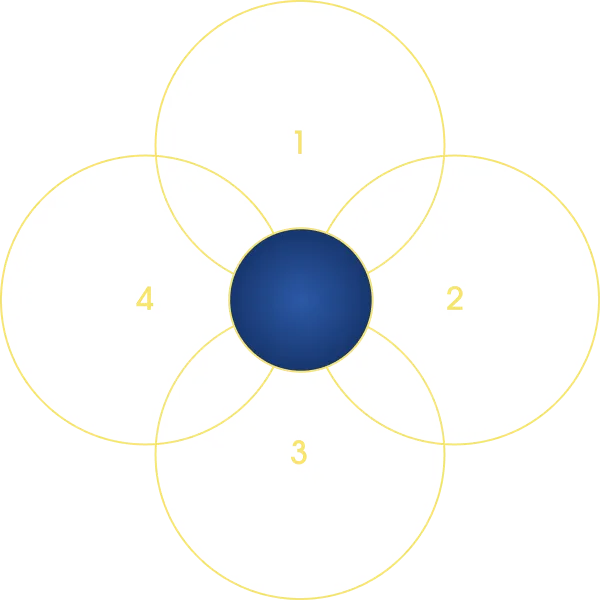
1
Strategy and deployment
Hoshin Kanri: a goal and indicators at every level.
2
Standard processes
5S, standardized work, equipment maintenance.
3
Daily management
Information centers, autonomous teams, managers' routines.
4
Problem solving
Focus projects, root causes, kaizen.

Lean culture
the foundation of the four
Losses
Lean manufacturing is a way of organizing work so that losses at every stage are visible and systematically eliminated.
System
We implement it as a system of five elements that exists in every company.
Lean manufacturing is a way of organizing work so that losses at every stage are visible and systematically eliminated.
We implement it as a system of five elements that exists in every company.
Maturity
The difference between plants is only in how developed these elements are.
Result
Everyone sees the value stream and can influence it before something undesirable happens.
The difference between plants is only in how developed these elements are.
Everyone sees the value stream and can influence it before something undesirable happens.
What changes for you
ONE PROGRAM – THREE VIEWS OF THE RESULT

Owner, CEO

A strategy cascaded to the work-area level
and clear to every supervisor
Manageability without manual control: decisions where the problem arises
A system as a competitive advantage, independent of external factors and of the consultant

Chief Operating Officer, Production Director
A loss-collection system and OEE in every area — you know where the money goes
A stable flow: changeovers, inventory, equipment maintenance
Supervisors who improve the system rather than fight fires

HR Director, L&D
Trained team leaders with a standard workday
Qualification captured in standards, not in the heads
of individual specialists
Transparent pay linked to productivity — engagement you don’t have to buy

Show the program to your manager
A detailed description of each of the seven stages: which problems are solved, which actions are taken and what result is expected.
How the program differs
Results hold after we are gone
Everything needed for growth is already inside the company: people, knowledge, skills.
Usually two things are missing — a vision of what to do and the energy for change. We close that gap and build the program so that new practices become habits.
Coaching instead of doing the work “for them”
Managers lead their teams themselves. The consultant trains and gives feedback after every session.
Problems are solved at their own level
Autonomous teams do not escalate to the director what they can close in an 8-minute meeting.
Quick wins from month one
A team cannot wait a year for a big result — must-win battles are planned right away.
Standards, training and rewards lock in the change
Even under threat to their health, only one in seven people changes habits on their own. That is why institutionalization is a stage of its own.
Results
What changed at the companies we have worked with
Sanitary and hygiene products
Shop-floor productivity without
capital investment
A performance management system on the main line: all losses are identified and tracked in real time, with a plan for each category. Scrap and material waste went down.
−50%
Pharmaceutical production
Equipment changeover time
SMED as a business process: training, support of eight pilot projects, standardization. Changeover time was cut in half, and the company now runs projects on its own.
−41%
Automotive components
Assembly line labor intensity
Time study and a Yamazumi chart showed that half of working time was waste. We changed takt, balanced operations, and introduced 5S and standardized work.
Savings — UAH 2.3 million.
Methodology and partners
Methodology and partners

Shingo Model
Principles of operational excellence: by managing behavior and culture, you determine the results.
BPI Group has been a licensed affiliate of the Shingo Institute since 2019 and one of 15 authorized providers of the model worldwide.

CDI Way, Mini-Business Units
Policy deployment through autonomous mini-business teams with their own KPIs.
The basis of our daily management system: a partnership with CDI Global — 25 years, 5,000 sites, 78 countries.
Lean Six Sigma tools
During implementation, the client’s teams are trained in Lean Six Sigma programs — Yellow and Green Belt.
Knowledge is passed into the company, and skills are practiced on real improvement projects. The programs are accredited by the Council for Six Sigma Certification (USA).
The program also uses Hoshin Kanri — deploying strategy down to the shop and work-area level — and Loss / Cost Deployment under the Yamashina–Kubo methodology: quantify all losses, calculate their cost and ROI.
consultants, each with over 10 years of experience in production
hours each team spends at the client's site
lean transformations every year since 2008
training programs supporting the full range of transformational change
QUESTIONS
Frequently asked questions
What gets asked at the first meeting. If your question isn’t here, write to us and we will answer personally.
How long does the program last?
The base master plan is designed for 12 months. Stages 0–2 — preparation, loss assessment and the daily management system — fall in the first half-year, stages 3–5 run in parallel in the second. The first verifiable result appears at stage 2, when area meetings start to run by protocol without the director. The exact timeline is set by the audit: it depends on the number of lines, areas and sites.
Does production stop during the project?
No. Work is done on running lines: loss data collection, short meetings, standardization and focus projects are built into the normal rhythm of the shift. Only activities that take people off production are planned separately — a two-day strategy session and workshops, for example SMED on a real changeover.
How is a “production system” different from “implementing lean”?
Lean implementation is often understood as a set of tools: 5S, SMED, kanban. They give a local effect that lasts only while someone is watching. A production system is five connected elements: strategy, standard processes and work environment, daily management, problem solving, and the lean mindset that everything else rests on. Tools are only part of one element, which is why the program doesn’t start with them.
We are a small-batch make-to-order manufacturer. Does this work?
Yes, and the potential here is usually greater than in mass production: the main losses are changeovers, waiting, work in progress and missed deadlines. The emphasis changes, not the method: instead of leveling flow to a warehouse — smaller batches, SMED and managing the order queue by OTIF; standardized work is built at the operation level, not for the whole line. The daily management system and autonomous teams work the same in both types of production. What is harder is that standards have to be flexible, and this takes more time at the process standardization stage.
Is it suitable for a company of 100–150 people?
Yes. The team structure and the number of information centers scale to size: in a small company the coordination council often coincides with the top management team, and the stages go faster. There is one constraint, and it is not about size — the personal involvement of the top manager is required. If the owner delegates the program to a “lean person in charge”, it will not hold at 100 people or at 1,000.
Who needs to be involved on our side?
The CEO or owner — in the coordination council and the strategy session; the operations or production director — as program leader; shop managers, supervisors and team leads — as team leaders; HR — for training and the skills matrix. The main load falls on team leaders: a few hours a week on routines and project group work. We train and coach, but your people lead the teams — otherwise the system leaves with the consultant.
Our supervisors are busy firefighting and have no time.
That is a description of the very problem the program solves. Fires happen because deviations are noticed late and resolved at the wrong level: everything escalates to the shop manager and the director. The daily management stage rebuilds the supervisor’s day itself — a standard workday, the eight-minute team meeting, escalation rules, the gemba walk. For the first two or three months this really is extra workload; after that the time lost to emergencies shrinks by more than the routines cost.
What if we already have 5S or calculate OEE?
The audit will show what maturity level these practices are at and whether they work as part of a system. A typical picture: 5S stopped at cleaning and has no audits, and OEE is calculated but no decisions are made on it. We do not redo what works; we build it into the team structure, the KPI tree and managers’ routines. The starting point changes the content of the program, not its logic.
Do we need to pay staff for taking part in improvements?
Separate payment for submitted suggestions usually works for a few months and then starts to do harm: people count ideas instead of solving problems. We build motivation differently — participation in improvements is built into the role and the team’s indicators, and contributions are recognized publicly on the information center. What matters is cycle speed: a suggestion is reviewed and implemented in days, not months. If a project’s effect is calculated, it is logical to reflect it in the bonus for the area’s results, not in payment for the number of kaizens submitted.
How much does the program cost?
The price is set after the audit, because it depends on the number of lines, areas, teams and sites. It consists of consultant days on site: in the master plan the number of days is fixed for each sub-stage, and you see it before signing the contract. You can start with the audit — a standalone service of limited scope: you get a loss assessment, the maturity level of your practices and a transformation plan regardless of whether we work together afterwards. At the assessment stage losses are quantified and each focus project gets an ROI calculation, so the scope of work can be compared with the expected effect.
RELATED SERVICES
Production system audit
Assessment of losses, practice maturity and management readiness. The first stage of the program.
Operational management
A daily performance management system as a standalone project.
Lean
Manager
A manager training program accredited by CSSC.
For those who lead change from within.
Hoshin Kanri / Policy Deployment
Turn your strategic vision into a coherent system of goals and actions — from the leadership to every department. The methodology ensures transparency, alignment and results at all levels of the organization.
Where to start
The first step is a production system audit
The audit is the first stage of the program and at the same time a standalone, low-risk product: you get the assessment and the plan regardless of whether you continue working with us.
- Improvement potential in processes: Loss/Cost Deployment for the main lines
- Practice maturity level under the BPI Lean audit methodology
- Management readiness for transformation
- A team development program and a transformation plan presented to management
Contact us directly
We reply within a business day. The duration and format of the audit depend on the number of lines and sites.