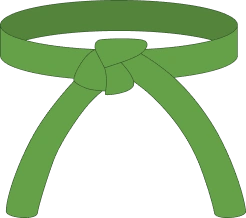
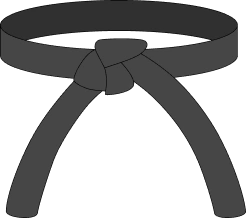
The methodology is learned in several stages. After completing each stage, the participant confirms the corresponding qualification and receives a belt that defines that level.
Yellow Belt
Has basic knowledge of the methodology and tools for process improvement. Takes part in projects led by Green and Black Belts.
Involvement in LSS projects
15–30%
Role in projects
Team member
Scale of value
Local waste
Green Belt
Takes part in large-scale Six Sigma projects led by a Black Belt or leads small projects in their own area of work.
Involvement in LSS projects
25–50%
Role in projects
Project leader
Scale of value
Department processes
Black Belt
Leads large-scale Six Sigma projects or programs. Has deep knowledge of the methodology and statistical analysis, and coaches Green and Yellow Belts.
Involvement in LSS projects
100%
Role in projects
Expert and mentor
Scale of value
Cross-functional waste
ACCREDITATION
CSSC certified program
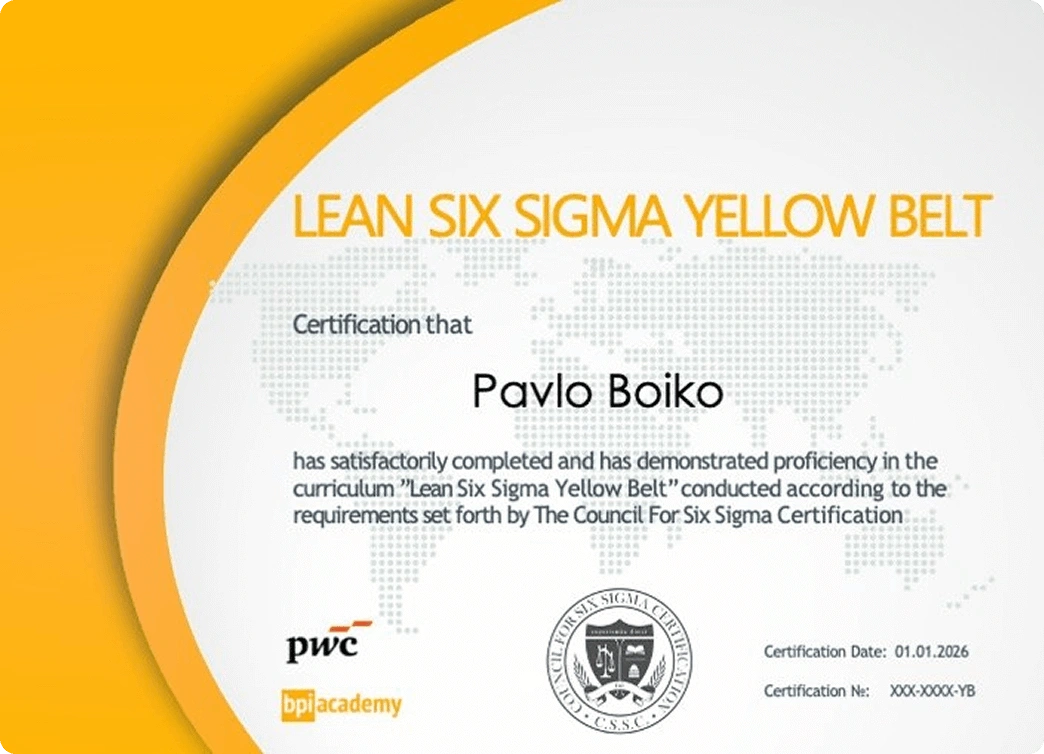
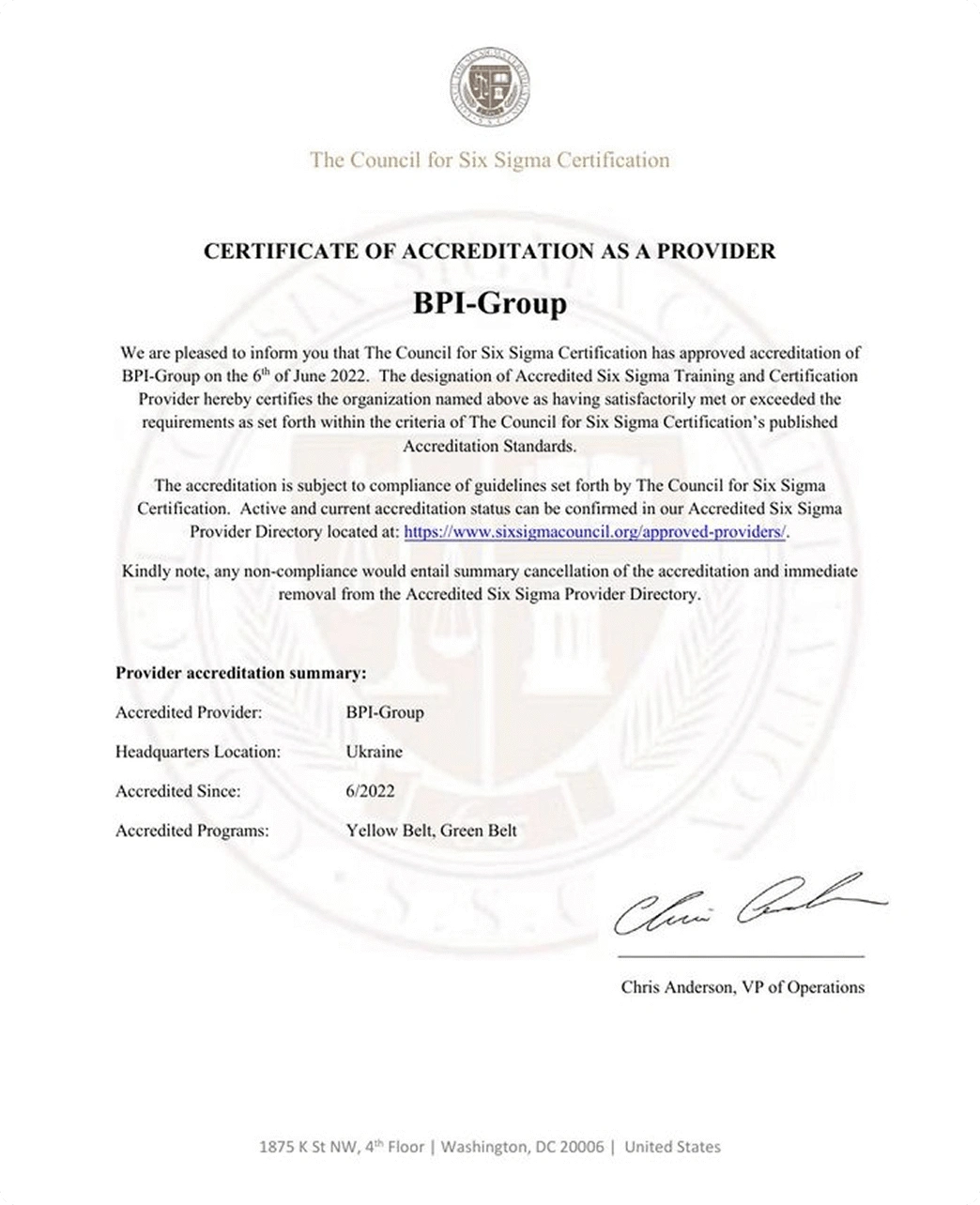
On completing the training, participants receive a certificate of completion accredited by the Council for Six Sigma Certification (USA). The program corresponds to the Lean Six Sigma Yellow Belt level.
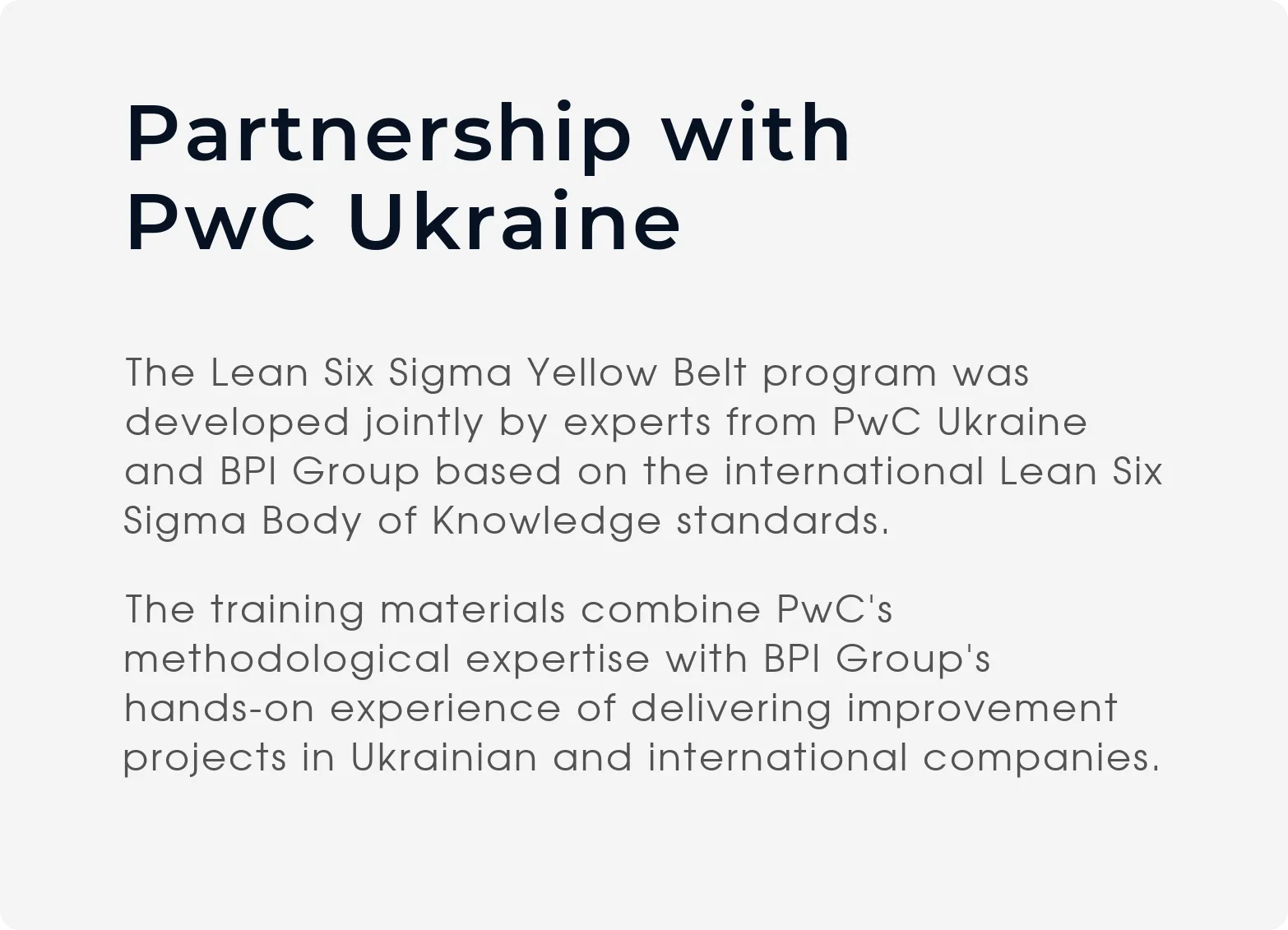
The program was developed jointly by experts from PwC Ukraine and BPI Group. It fully meets the requirements set by the Council for Six Sigma Certification and defined in the CSSC Lean Six Sigma Yellow Belt Body of Knowledge.
TARGET AUDIENCE
Who the Yellow Belt program is for
Production
staff
Foremen
and supervisors
Program
goal
To teach participants to see waste and variation in processes, describe a process at a high level, understand customer requirements, apply basic Lean Six Sigma tools and contribute effectively to improvement projects.
Engineers
and technologists
Quality
specialists
Logistics, procurement and planning staff
Important
The program gives participants a common language, a clear framework and a set of practical tools to spot problems, structure them and support improvements in their team.
To teach participants to see waste and variation in processes, describe a process at a high level, understand customer requirements, apply basic Lean Six Sigma tools and contribute effectively to improvement projects.
1. Production staff
2. Foremen and supervisors
3. Engineers and technologists
4. Quality specialists
5. Logistics, procurement and planning staff
6. Office and service functions
7. New team leaders
Important
The program gives participants a common language, a clear framework and a set of practical tools to spot problems, structure them and support improvements in their team.
What the participant gets and what the business gets
What the participant gets
An understanding of the DMAIC framework and their role in it
The skill to tell a symptom from a cause
The ability to work with data instead of opinions
A ready-to-use 30-day action plan
What the business gets
A team that speaks the language of facts and metrics
More eyes that see waste and variation
Support for Green/Black Belt projects
A culture of structured problem solving
Training that pays back on the very first project
GRADUATE SKILLS
6 key Yellow Belt competencies
01
PROCESS AWARENESS
See a process as a system
Understand a process as a system of inputs, steps, outputs and owners.
04
BASIC DATA THINKING
Work with data
Use simple data and metrics instead of subjective opinions.
02
WASTE AWARENESS
Spot waste
See unnecessary actions, waiting, defects and hidden costs in everyday work.
05
STRUCTURED
PROBLEM SOLVING
Solve problems in a structured way
Define the problem, look for root causes and check the logic.
03
CUSTOMER THINKING
Think from the customer
Work with abstract “customer wishes” (Voice of the Customer, VoC) and turn them into strict, measurable requirements (CTQ).
06
IMPROVEMENT
PARTICIPATION
Be part of an improvement team
Take part in an improvement team and support the implementation of solutions.
GRADUATE SKILLS
6 key Yellow Belt competencies
01
PROCESS AWARENESS
See a process as a system
Understand a process as a system of inputs, steps, outputs and owners.
02
WASTE AWARENESS
Spot waste
See unnecessary actions, waiting, defects and hidden costs in everyday work.
03
CUSTOMER THINKING
Think from the customer
Work with abstract “customer wishes” (Voice of the Customer, VoC) and turn them into strict, measurable requirements (CTQ).
04
BASIC DATA THINKING
Work with data
Use simple data and metrics instead of subjective opinions.
05
STRUCTURED PROBLEM SOLVING
Solve problems in a structured way
Define the problem, look for root causes and check the logic.
06
IMPROVEMENT PARTICIPATION
Be part of an improvement team
Take part in an improvement team and support the implementation of solutions.
GRADUATE SKILLS
6 key Yellow Belt competencies
01
PROCESS AWARENESS
See a process as a system
Understand a process as a system of inputs, steps, outputs and owners.
02
WASTE AWARENESS
Spot waste
See unnecessary actions, waiting, defects and hidden costs in everyday work.
03
CUSTOMER THINKING
Think from the customer
Work with abstract “customer wishes” (Voice of the Customer, VoC) and turn them into strict, measurable requirements (CTQ).
04
BASIC DATA THINKING
Work with data
Use simple data and metrics instead of subjective opinions.
05
STRUCTURED
PROBLEM SOLVING
Solve problems in a structured way
Define the problem, look for root causes and check the logic.
06
IMPROVEMENT
PARTICIPATION
Be part of an improvement team
Take part in an improvement team and support the implementation of solutions.
CURRICULUM
28 hours of practical and theoretical sessions
28 hours of practical and theoretical sessions
28 hours of practical and theoretical sessions
Every session is live with a trainer in Zoom at 10:00.
The program follows
the improvement cycle:
25
September
DEFINE
Define the problem and describe the process
Introduction to Lean and Six Sigma (Lean Six Sigma). High-level process map (SIPOC). Voice of the Customer and Critical to Quality requirements. Cost of quality and cost of non-conformance. Problem statement.
Outcome
You will be able to describe any process at a high level, state the problem and identify what the customer values
28
September
MEASURE
Measure the current state of the process
Standard deviation and variation. Defects per unit and defects per million opportunities. Process sigma level. First pass yield and rolled throughput yield. Pareto chart. Methods of collecting and organizing data.
Outcome
You will be able to measure process quality in numbers, determine the defect level and build a priority chart
8
October
ANALYZE
Analysis of waste in the process
Value-adding and non-value-adding activities. Seven plus three types of waste. Type 1 and type 2 waste. Observation at the workplace (Gemba). Waste walk. Waste log.
Outcome
You will be able to see and document hidden waste in any process — production, office or logistics
9
October
ANALYZE
Root cause analysis
The “5 Whys” method for finding the root cause. The link between the outcome and influencing factors. The difference between a symptom and a cause. Cause-and-effect thinking. Building a logical chain from the problem to the root cause.
Outcome
You will be able to tell a symptom from a cause and find the root cause of a problem using a structured approach
22
October
IMPROVE
Lean improvement tools
The 5S workplace organization system. Visual management. Standardization of processes and work operations. Standard operating procedure for a repeatable result.
Outcome
You will be able to implement 5S at the workplace, create a visual standard and write a work instruction
23
October
IMPROVE
Choosing solutions and planning implementation
Criteria for choosing countermeasures. Evaluating solutions by impact and effort. Action planning with owners and deadlines. The improvement story — how to describe a project from problem to result.
Outcome
You will be able to choose the best solution, draw up an action plan and write an improvement story for reporting
29
October
CONTROL
Sustain the result achieved
Control plan: who checks what and how often after implementation. Methods for locking in changes and preventing a return to old practices. A full review of the improvement cycle. The difference between improving a process and designing a new one.
Outcome
You will be able to create a control plan that sustains the improvement without constant manual supervision
6
November
INTEGRATION
Mini-project defense and certification
Presenting the improvement story to the group. Peer assessment of projects. Final test (pass mark 70%). Building an individual 30-day action plan after the training.
Outcome
You will be able to defend an improvement project in front of an audience and receive the Yellow Belt certificate
The most valuable thing is that I learned to tell a symptom from the real cause. I stopped “firefighting” and started removing the root of the problem. It completely changed my approach to work.
Viktor T.
Process engineer
I sent three people from my team to the training. They came back with a concrete plan and have already launched their first improvement project. The investment paid off faster than I expected.
Andriy S.
Head of operations
I was afraid there would be complex statistics and formulas. Instead — clear examples and ready-made templates that I use every day. Defending the mini-project at the end gave me confidence.
Iryna P.
Quality specialist
What surprised me most was that the tools work not only in production. I’m from the logistics department — and within a week I saw how much time we lose on approvals. Now I see processes in a completely different way.
Olena K.
Logistics specialist
We used to argue on emotions in meetings. After the course I started coming with data — and discussions became shorter and decisions better grounded. The team speaks the same language.
I was afraid there would be complex statistics and formulas. Instead — clear examples and ready-made templates that I use every day. Defending the mini-project at the end gave me confidence.
Sessions are held live in Zoom with a trainer. This is not a recorded course — you work in a group, ask questions and do practical exercises in real time. After each session the recording becomes available in your account in case you need to review the material.
The recording of every session will be available in your personal account throughout the course. You can watch the module you missed and complete the homework. If you have questions about the material, the trainer will answer them in the group chat or at the next session.
After passing the final test (pass mark 70%) and defending your mini-project, you receive a Lean Six Sigma Yellow Belt certificate accredited by the Council for Six Sigma Certification (USA). The certificate is internationally recognized and does not expire.
You can retake the test. The program is designed so that if you attend the sessions and do the homework, the test is not difficult — it covers material you have already practised.
One session takes 2.5 hours per week (live in Zoom). Plus 1–1.5 hours of homework between sessions. In total 3.5–4 hours per week for 8 weeks. It is a comfortable pace that fits with a full-time job.
Yes. Lean Six Sigma applies to any process — production, logistics, service or administrative. In the program we go through “production + office” cases side by side, so that every participant can apply the tools in their own context straight away.
Yes, and we recommend it — when several people from one team train together, the effect of implementation is much greater. Special terms apply to groups of 3 or more participants. Contact us for a corporate offer.
Three key differences: live sessions with a practitioner trainer (not recorded videos), practical assignments based on real cases from Ukrainian and international companies, and an international CSSC (USA) certificate accredited to the Lean Six Sigma Body of Knowledge standards. The program materials were developed by the PwC Academy.
Payment is made by invoice (for companies) or online (for individuals). The program fee is UAH 24,900 excluding VAT. Corporate clients can arrange an individual payment schedule. Leave a request and we will discuss a convenient option.